While the PDA supports reform that genuinely improves patient care and professional practice, its response to the GPhC consultation is clear: patient safety depends on clear accountability, robust governance, and the physical presence of pharmacists in pharmacies. Any standards that dilute these first principles will put patients at risk.
Commercial pressures, workforce shortages, or funding constraints cannot justify lowering safety standards or reducing patient access to pharmacists. As the clinical role of community pharmacy continues to expand, the need for pharmacists to be present, supported, and properly governed has never been greater.
The PDA’s position is grounded in three core principles:
- Statutory roles must remain distinct and clearly defined
- System, governance, and premises accountability must rest with pharmacy owners and Superintendent Pharmacists, rather than being dispersed or obscured
- Pharmacists must be present and able to intervene at the point of care.
Distinct statutory roles are essential
Safe and effective pharmacy practice relies on two distinct but complementary statutory roles:
- Superintendent Pharmacists (SPs) hold continuous, overarching responsibility for governance, systems, staffing, and safety across the pharmacy business.
- Responsible Pharmacists (RPs) are accountable for the safe and effective running of an individual pharmacy on a particular day and must be free to exercise independent professional judgement without commercial pressure.
This distinction reflects Parliament’s intent when strengthening organisational governance in pharmacy. As currently drafted, elements of the proposed standards risk blurring responsibility for authorisation, decision‑making, and accountability. The PDA believes that when lines of responsibility are unclear, patient safety is compromised.
Superintendent Pharmacists: governance must be real, not symbolic
The PDA has long called for role-specific standards for SPs and welcomes their inclusion in principle. However, standards will only protect patients if they reflect the true significance and scale of the role.
The PDA believes that SPs must be senior leaders with genuine authority, not nominal appointees. This requires that they:
- meet minimum eligibility criteria before appointment
- have clear accountability for staffing levels, skill‑mix, training, systems, technology, wellbeing, and safe working environments
- provide explicit protection against non‑patient‑facing managers overruling professional clinical judgement.
Given that some SPs are responsible for hundreds of pharmacies and thousands of staff, accountability cannot be symbolic. It must be matched by demonstrable experience, competence, and authority.
Responsible Pharmacists: one pharmacy, one pharmacist, one clear duty
The PDA strongly supports the established rules that a RP can only be responsible for one pharmacy at a time, and must be present at the pharmacy where they are signed in.
These principles underpin public trust and ensure pharmacists are accessible when patients need them.
In its consultation response, the PDA continues to oppose any proposals that would allow RPs to supervise multiple pharmacies or operate remotely. Government impact assessments have already confirmed that remote supervision was never an intended policy outcome, and the PDA fully endorses that position.
The two‑hour absence rule is a critical safeguard
The PDA also strongly supports the retention of the existing two‑hour maximum absence rule for RPs. This safeguard has been in place since 2008 and reflects Parliament’s clear expectation that RPs should spend their time on the premises to fulfil their statutory duties.
As community pharmacies deliver an expanding range of complex clinical services including independent prescribing, the case for weakening this protection has diminished, not increased. The PDA’s view is that any extension of absence arrangements would reduce access to pharmacists and increase clinical risk. This is a clear red line for patient safety.
Authorisation must not become remote supervision by another name
A central concern in the PDA’s response is that authorisation frameworks must not be used as a back‑door route to remote supervision.
Poorly defined authorisation arrangements risk enabling routine pharmacist absence, reduced access to clinical expertise, and increased patient harm. The PDA’s position is unequivocal:
- authorisation must only operate where safe staffing and an appropriate skill‑mix are already in place
- pharmacists must never be pressured into granting authorisations
- accountability must remain clear and undiluted.
PDA members have expressed overwhelming opposition to remote or quasi‑remote supervision in any form. Any standards that facilitate this outcome are therefore unacceptable.
PDA calls for decisive revision of the draft standards
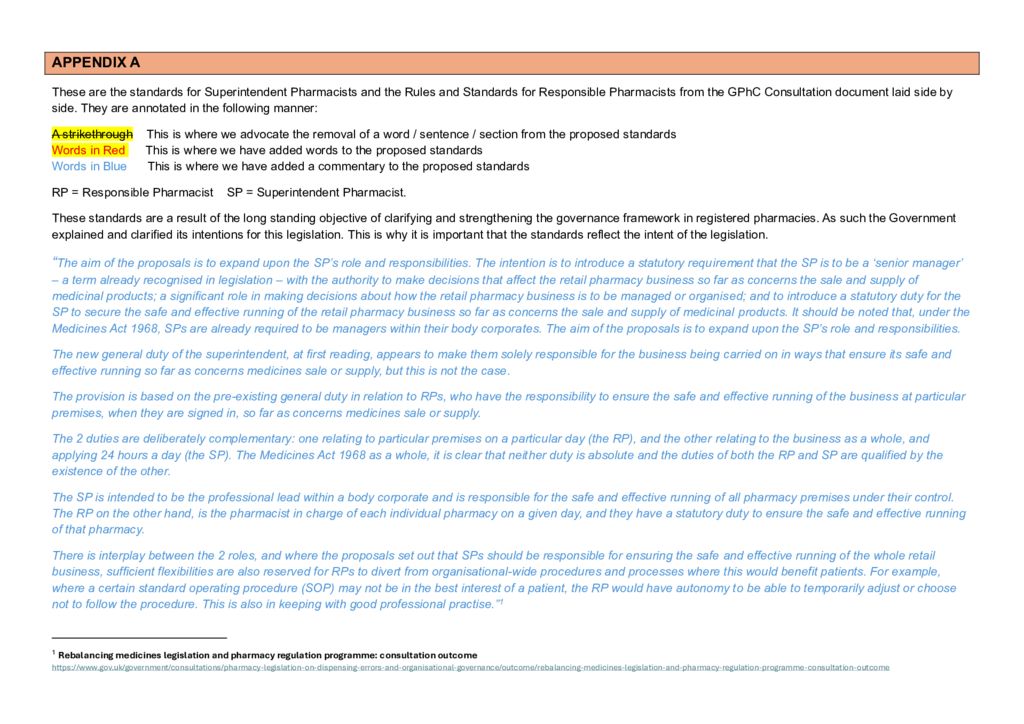
With its response, the PDA submitted an appendix including a side-by-side comparison of the draft standards, which identifies specific areas where clarification or revision is needed so that they:
- clearly reflect the distinct legal responsibilities of SPs and RPs
- explicitly prohibit the use of authorisation to facilitate remote supervision
- introduce minimum criteria for appointment as a SP
- ensure accountability for systems, staffing, wellbeing and technology rests with pharmacy owners and SPs and not with individual RPs.
The PDA believes that patient safety must come first. That requires pharmacists to be present and supported in every pharmacy, under regulatory arrangements that ensure accountability is clear and appropriately held.
READ THE PDA’S CONSULTATION RESPONSE HERE
READ THE SIDE-BY-SIDE STANDARDS HERE
Learn more
- PDA responds to DHSC consultation on pharmacy supervision
- Pharmacy Supervision Practice Group – Update and outcome
- Guidance to whether a Responsible Pharmacist can be in charge of more than one set of premises
- It’s time to kill off the Remote Supervision concept