In this issue:
- PDA at the NHS Staff Side Council: one year on
- ICBs: The current state of play
- A week in the life of a respiratory advanced practitioner
- Training and support for PDA Representatives
- Why I stepped up as a PDA Rep
- Get involved
- In case you missed it
PDA at the NHS Staff Side Council: one year on
The PDA has more than 6,000 pharmacist members employed on Agenda for Change contracts and became part of the NHS Staff Side structures late in 2024, significantly increasing pharmacists’ voice at NHS employers.As a result, just as with the specialist unions for radiographers, physiotherapists, dieticians, etc, there is now a place in the structures for the PDA. This enables the pharmacists’ organisation to champion any specific interests and concerns of the pharmacy profession and to better collaborate with sister unions to add the influence of the PDA’s total 40,000 members to matters impacting wider staff groups too.
At the national level, this includes participation in the work of the social partnership forum (SPF) with regular meetings chaired by the UK government minister Karin Smyth MP, bringing the staff side together with NHS employers and government to progress discussion on a wide range of issues impacting NHS employees. Though change impacting so many employers and employees is of necessity, something that happens at a considered pace, it nevertheless allows improvements to be made and for agreements to eventually keep up to date. A multitude of joint sub-groups and working parties of NHS employer and staff side representatives are working constantly throughout the year to progress matters under discussion, and the PDA now plays its part in these.
The fourteen Agenda for Change unions are the Association for Laboratory Medicine (until very recently called the Federation of Clinical Scientists), British Association of Occupational Therapists, British Dietetic Association, British Orthoptic Society, Chartered Society of Physiotherapy, GMB, PDA Union, Prison Officers Association, Royal College of Midwives, Royal College of Nursing, Royal College of Podiatry, Society of Radiographers, UNISON and Unite.
At each employer, in scope of the NHS Terms and Conditions of Service Handbook, there should also be a local staff structure at which each one of the 14 unions that have 1+ members at that employer should have a seat. If there is not already a PDA Representative involved in your employer’s local structures, perhaps it can be you. Training and support will be provided.
PDA Workplace Reps receive paid time away from their normal role, known as ‘facilities time’, to undertake their union duties, including being trained. Through their involvement in local structures, they can perform several important roles for pharmacists, including:
- Representing the experience and interests of local pharmacists at that employer in discussions about change. They can also bring the specific issues and concerns of pharmacists at that employer to that forum.
- Ensuring that the policies and entitlements, which have been agreed at the national level, are applied properly and consistently by their employer.
- Influencing those arrangements which are to be agreed locally on an employer-by-employer basis.
- Being trained to become part of local Job Evaluation processes, helping ensure that jobs are properly sized and therefore receive the appropriate pay band.
- Being the local eyes and ears of the PDA, able to engage with workplace reps at other NHS employers and with the PDA to identify good (and bad) practice and to then champion for the best in their workplace.
- Support fellow colleague PDA members who have a dispute at work.
All four UK nations are involved in the NHS Staff Side structures, with the most significant difference being where NHS Scotland and the trade unions negotiate pay and other conditions at the Scottish Terms and Conditions (STAC) committee. The PDA Union is also part of the STAC structure.

ICBs: The current state of play
PDA members working in Integrated Care Boards (ICBs) have rightly been frustrated by the lack of clarity and information about the changes and direction of travel following the announcement of 50% cuts to ICBs back in March 2025.
The PDA has held two meetings for all affected PDA members in April and August, with over 100 attendees at the last meeting and finally, the Medicines Optimisation good practice document has been shared. The PDA welcomes some direction on the future of medicines optimisation teams and is pleased to see clarity on the importance of that work. Our view is that those employees should remain as employees within the NHS, and we will support members to make the case for this.
As discussed at the meeting for members in August, it has become apparent that any restructure for most staff will not happen until after Christmas in Quarter 4, and that current activity is focused on the restructure of the executive teams. There is still no clarity on a nationally funded voluntary redundancy scheme, and the working assumption is that there will not be one. Most ICBs are not financially in a position to offer one, and so certainly those undergoing restructure at the executive level appear to be in a position where, if they are not successful in obtaining a new post, they will be made compulsory redundant. The PDA will issue more guidance on this, but a factsheet on employees’ rights during a redundancy briefing can be foundhere.
During this period of time, many new members have stepped up to become PDA Workplace Reps in ICBs, which has enabled the PDA to represent members’ concerns locally at individual ICBs. This is a really significant development, enabling the PDA to spread our influence and better represent our members. If you would like to join this growing group of representatives, please email[email protected].
More information about becoming a PDA NHS Representative can be foundhere.
A week in the life of a respiratory advanced practitioner
There are different pathways to achieving the title of advanced practitioner and this area of clinical practice has been undergoing a lot of development since it came to be. Nowadays, the most popular way of becoming an ACP is either through an accredited MSc apprenticeship course at a university or through an e-portfolio-supported route. In my case, I signed up to my ACP MSc right after I finished my Independent Prescribing (IP) course, as I considered it a natural way of developing my skills in examination, diagnosis, leadership and research. Every advanced practitioner works across four pillars of advanced practice which are clinical, research, leadership and Education.
A week in my life
Here, I will try to show you what my week looks like with examples spread across the four pillars. When it comes to the most important part of my week, it is the clinical duties. I have two general respiratory clinics a week, where the GPs and consultants from other specialities refer to the respiratory team for our opinion, and some of those patients come to see me. I am often the first point of contact for patients presenting with a wide range of respiratory symptoms. I also run a specialist asthma clinic that works as a spoke to the local severe asthma centre, working up patients for biologics, checking adherence and working collaboratively with the physiotherapy team to provide the best care available. I also often see asthma patients on the wards, especially when I take part in the junior respiratory ward round, often seeing patients with general medical problems independently and making decisions on my own and with the support of my seniors. In this part of my job, the hands-on examination skills and ability to conduct thorough patient examinations is paramount.
Training and support for PDA Representatives
Are you interested in becoming a PDA Representative? The number of work-based PDA Representatives in the NHS has grown substantially in the last couple of years, enabling the PDA to be represented and have influence both at national and local level.
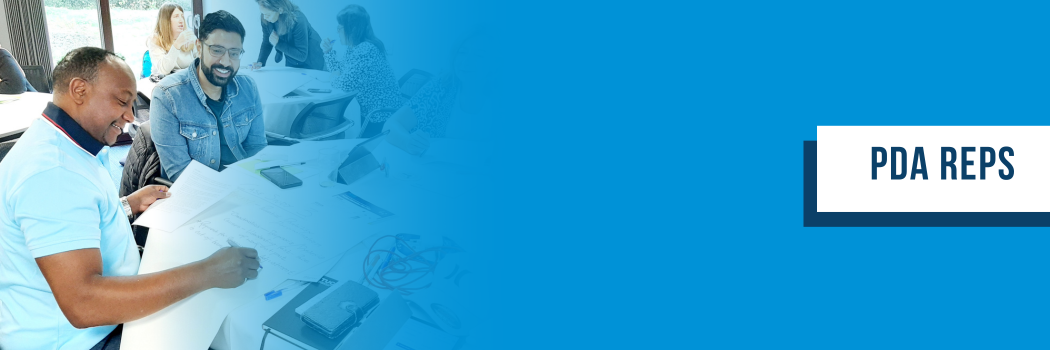
As a PDA representative, you will be offered full training and support. Initially, you are invited to complete a PDA Reps’ online induction, which gives a broad overview of how the PDA works and what the role of the PDA Representative involves. Once this has been completed, there are further opportunities to attend face-to-face training, which enables you to understand in more detail your legal rights as a trade union rep and some of the roles and work you may do as part of trade union duties. In addition, bespoke training for PDA NHS Reps has been developed, such as an online course on building confidence to speak in JNCC meetings, and another is being planned on how to support members during restructures and management of change.
Anne Jones, a PDA Rep for Cornwall and Isles of Scilly said,“I genuinely enjoyed the course and was glad I had attended. Emma is a great trainer, very knowledgeable and engaging; the two days flew by.
I feel more confident about the role of PDA Rep, the activities that reps can undertake and most importantly, the support that is available to reps. It was great to have the opportunity to network with other PDA Reps and it was well worth travelling to Birmingham to participate.
I would strongly encourage other reps to accept the invitation to this in-person training.”
In addition, the PDA provides mentoring and support to individual reps.
If you are interested in becoming a PDA Representative in your workplace, please email[email protected]and we will be in touch to discuss this with you.

Why I stepped up as a PDA Rep
The PDA training has been another highlight. It equips you with so many interpersonal and professional skills you might never have formally thought about before. Plus, the opportunity to interact with such a diverse group of pharmacists from across all sectors is incredibly enriching; it’s networking at its best, learning from others, and bringing back those insights to your own workplace.
For me, being a PDA Rep is about connecting colleagues and leadership, supporting positive change, and ensuring that every voice is heard. It has sharpened my skills, broadened my network, and, most importantly, allowed me to make a meaningful difference in the workplace.
Get involved
Those who wish can become a PDA Workplace Rep here or they can also get involved with their Regional Committee here.
The PDA also has four Equality, Diversity, and Inclusion (EDI) Networks available for members to join. All networks welcome allies and PDA Student and PDA Trainee members can join for FREE. More information can be found here.
We encourage you to forward this newsletter to colleagues who you feel may find it interesting and if they are not yet members of the PDA and wish to join they can do so here.
In case you missed it
- PDA welcomes change of NHS England policy on subcos
- Ministers must make good on NHS pay-talk promises, says PDA and other health unions
- PDA provides ongoing support to ICB, CSU and NHSE members
- Potential redundancies in ICBs, CSUs and NHSE
- Regulatory definition of NHS managers must include all those responsible for providing NHS services
- PDA responds to the NHS 10 Year Plan
- Another Employment Tribunal win for an NHS pharmacist
- PDA secures Employment Tribunal win for redundant NHS pharmacist
- PDA members to respond to proposed 3.6% NHS pay increase