A time for reflection and recalibration
The PDA’s interest in the proposals and the ballot stems from the fact that even though many pharmacists are not members of the RPS, the changes that have been proposed could potentially impact all pharmacists. Done intelligently, the changes could not only lead to the RPS doing things differently but could also lead to other organisations adapting in concert, working symbiotically for the benefit of the wider profession.
Throughout the debate on the future of the RPS, as the largest pharmacist membership organisation in the UK, the Pharmacists’ Defence Association (PDA) has consistently emphasised the need to exploit the opportunity for a strategic, well-considered and collaborative change.
While recognising that change is often necessary, a PDA survey of over 2,000 pharmacists revealed that only 11% felt well-informed about the proposals ahead of the vote. This is why, the PDA advocated for a delay in the ballot, to enable a more deliberative and inclusive process, allowing more time for discussion and consensus-building. The detailed proposals for the charter changes for conversion into a charity were published just twenty working days before the vote was scheduled and was done after the roadshows had been completed.
Failing a delay, the PDA called for a NO vote to enable additional and sufficient time to be given.
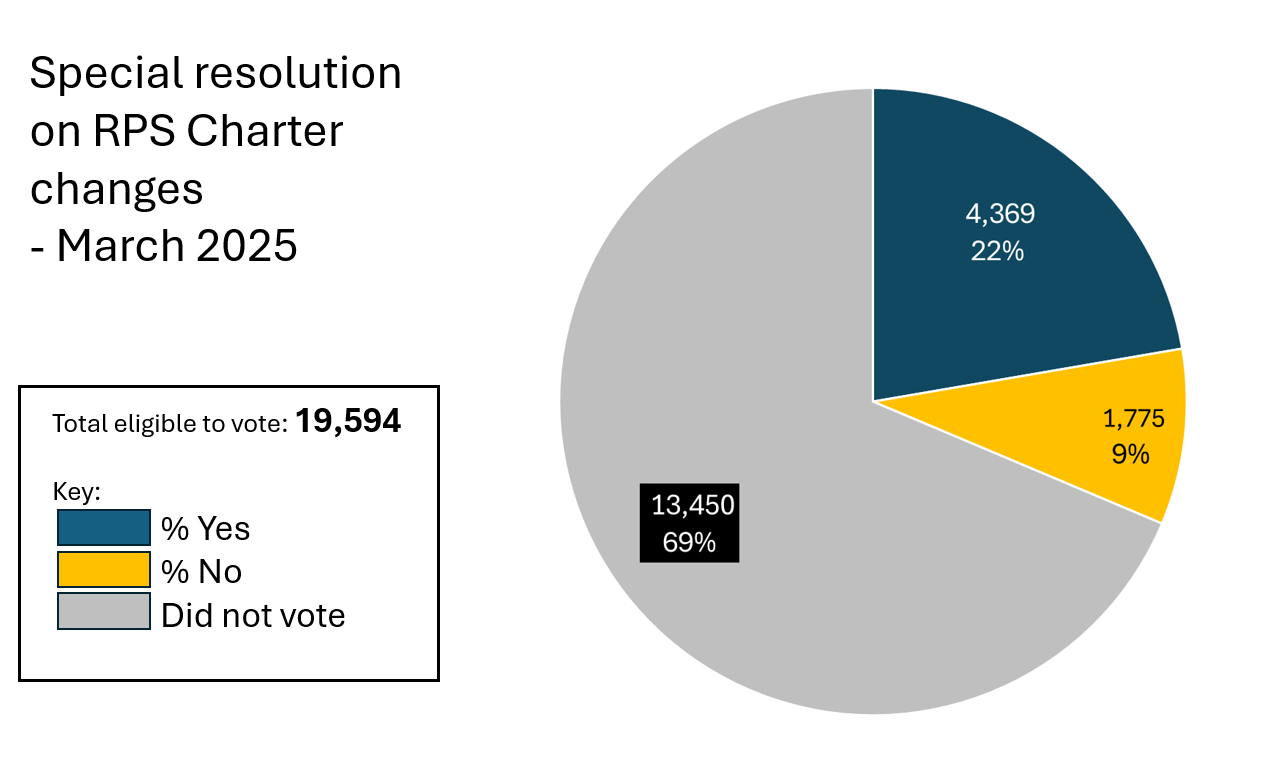
The ballot result was that 22% of the RPS’s members voted for the change and 9% voted against. Those voting in favour represent less than 7% of all pharmacists in Great Britain (as there are more than 45,000 pharmacists who are not RPS members). With more than two thirds of all RPS members not involved in the voting at all, coupled with such a low level of detailed understanding of the proposals, only the passage of time will make it apparent what may have been gained and what may have been lost.
The transfer from pharmacist interest to public interest
During the ballot process it became clear that a previous RPS charter objective to ‘safeguard, maintain the honour, and promote the interests of pharmacists’, was to be lost.
The RPS’s lawyers have confirmed on the RPS website that, “It is not possible for a charity to have the object to ‘maintain the honour, and promote the interests of pharmacists.’ A charity cannot have a purpose to benefit, or further the interests of, a defined group of individuals who are not themselves the objects of the charity.”
Some pharmacists have argued that this is a retrograde step for the profession, that the conversion to a Royal College could have been done in a different way, without the loss of this objective and supported campaigns to vote NO.
Some RPS members have disagreed that the conversion to a charity could be based on two-thirds of those voting as opposed to two-thirds of all RPS members. This resulted in a response published by the RPS lawyers on its website. The PDA believes that these developments are the potentially damaging consequences of moving too hastily to a ballot and not sufficiently engaging the whole profession before calling the vote.
However, the clarification from the RPS lawyers as to what the Royal College can and cannot do will at least help the profession to consider how best to adapt, ensuring that pharmacists can still expect to receive professional representation of their interests.
Aligning the pharmacy ecosystem for collective success
The hard work starts now; moving forward, there needs to be a broader conversation about how this can all work. This transition presents an opportunity to recalibrate the pharmacy ecosystem – aligning the strengths of all representative bodies to achieve outcomes that surpass the sum of individual efforts. The profession’s success will depend on collaboration across all sectors, ensuring that all pharmacists benefit from a more cohesive and strategically aligned landscape, regardless of their affiliations.
Crucially, leadership within the profession exists in many forms, and from many organisations, for example professional bodies, trade bodies, unions, employers, academic institutions and individual professionals advocating for themselves, for their colleagues and for patients. Recognising and leveraging this distributed leadership is essential for fostering a resilient, but flexible, pharmacy ecosystem enabled to drive the profession forward and embrace change.
A profession poised for growth
While questions remain about the long-term implications of this transition, what is clear is the need for a symbiotic approach. Pharmacists need to be clear as to where they go for what and how they can be supported in the practice of their profession.
By fostering collaborative partnerships and leveraging collective strengths and legitimate roles of the various pharmacy organisations, an opportunity to create a newly reconfigured thriving, dynamic profession presents itself. One which is well-positioned to navigate future challenges and opportunities presented in delivering pharmaceutical care and healthcare provision. The PDA calls for all stakeholders – pharmacists, professional bodies, and representative organisations – to engage in meaningful and collaborative dialogue.
With more than 39,000 members, the PDA is the largest pharmacist membership organisation in the UK. It will always continue to observe its stated objectives to, ‘provide leadership and representation for employed and self-employed pharmacists, and to those in training” and to “protect, defend, lobby for and support the interests and reputations of pharmacists’.
As this new chapter unfolds, the PDA will continue to monitor developments, advocating for an inclusive and pragmatic approach to ensuring that the pharmacist profession becomes stronger and more unified in its pursuit of excellence.
Learn more
- PDA seeks pharmacists’ views on an important decision on the future of pharmacy
- PDA says vote ‘NO’ to current RPS charter proposals if they will not cancel ballot
- PDA calls for a NO Vote in the RPS Charter ballot
Not yet a PDA member?
If you have not yet joined the PDA, we encourage you to join today and ask your colleagues to do the same.
Membership is FREE to pharmacy students, trainee pharmacists and for the first three months of being newly qualified.
Read about our key member benefits here.